
This blog is part of Action for Race Equality’s Racial Terminology Project series, exploring how racial terminology is used, understood and debated across the UK today.
Estimated read time: 4 minutes
Why focus on terminology?
In 2024, ARE revisited this project, seeking to better understand the way individuals and organisations use racial terminology across the UK. Through a UK-wide survey, focus groups with young people, and consultation with other anti-racist voluntary sector organisations, we sought to better understand how individuals and organisations use racial terminology today.
We wanted to focus on the language our communities use to describe themselves, rather than the language of racism, with the view to strengthening the understanding of the rich and complex cultural identities across the UK today.
Throughout our consultation, a common question emerged: Is focusing on language a distraction from addressing the material realties of racism?
Many of the organisations we work with, including our own, are involved in directly working to address racial disparities in Education, Employment, and Criminal Justice. Against that backdrop, spending time and resources on terminology could appear secondary to more immediate and urgent work.
More than a distraction, some participants identified dangers to partaking in the creation of racial terminology. Racial terminology can be found in service to perpetuating colonial legacies of categorisation, scientific racism, and racial segregation. These are serious and valid concerns, especially when considered alongside rising far-right sentiment, a resurgence of scientific racism, and a fractured understanding of race and racism in UK society.
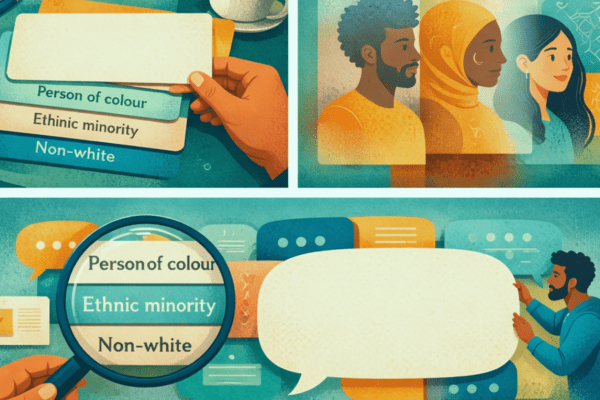
There is a temptation to believe that the conversation on terminology could be bypassed and that there is ‘simple’, or ‘common-sense’ terminology that we could revert to, and a belief that people prefer old terms and are inherently sceptical of new language. Simplified categories like ‘White/non-White’, or ‘Black/non-Black’ might not work for complex racialised experiences, but on the other hand, when language changes too quickly it can be confusing.
[Speaking about the shared experiences of racialisation] I think we need to explain the experience. If this is your experience, you’re with us, if this is not your experience, you’re not with us. And then, what it is we’re willing to do about changing that experience. That’s the agenda we put out that clarifies people, and who doesn’t stand with us stands against us.”
– Racial Terminology Project Focus Group Participant
Terminology can be the crucial tool in building this shared understanding of collective experiences. Categorisation and ethnicity data collection were identified by participants as indispensable tools for identifying structural racism in policymaking. Without ethnicity categories and data collection, the understanding of inequities would be limited.
Having a national picture of school exclusions by ethnicity or violence in prisons allows us to evidence the lived truths of racism to policymakers and legislators. Throughout our work with young people, we see how young people’s ability to understand and articulate their experiences of racism can be transformed by discussing terminology.
Naming the problem is a powerful action. Amongst by and for led organisations fighting for racial justice, it might be useful to see terminology as a tool; not separate from the fight for racial equity but an integral part of it.
Further reading on racial terminology:
There have been several similar and compelling studies in this area over the past few years.
These studies situate our project in the context of an ongoing national conversation on racial terminology and the awareness that many organisations deem it necessary to demonstrate they are engaged in this discourse. It is important to hold organisations to account when optics take priority over action, but we believe that having better conversations about terminology and language are a crucial first step to addressing racism.
‘Contains Strong Language: A Guide to Talking About Racism’ | Reframing Race 2023
‘Race and opportunity in Britain: finding common ground’ | British Future 2021
‘Lets talk about Race’, Toolkit | Business in the Community 2023
‘A guide to race and ethnicity terminology and language’ | The Law Society 2025
This blog is part of a series on our Racial Terminology Project. To find out more and access our toolkit, visit here.