This blog is part of Action for Race Equality’s Racial Terminology Project series, exploring how racial terminology is used, understood and debated across the UK today.
Estimated read time: 5 minutes
Questions of British identity and who and what counts as ‘Britishness’ have often been a site of contest for Black, Asian, and Mixed Heritage communities in the UK. As part of our Racial Terminology Project, it occasionally surfaced in research groups, alongside discussion of the limited scope of the Office for National Statistics ethnicity categories. Participants were interested in hybrid conceptions of Britishness, whilst struggling to identify with ‘British’ as a term to use on its own.
The 2021 British Future report ‘Race and opportunity in Britain: Finding common ground’ found the use of hyphenated identities were seen as more likely to be a positive driver of inclusion, rather than a source of fragmentation. Their attitudes data showed that the balance of ethnic minority opinion is towards seeing hyphenated identities as a potential route towards a shared British identity rather than a barrier to it.
Lit in Colour’ 2021 report has also highlighted duality in identity markers, noting the lack of a ’Black British’ option as a companion to the currently included ’White British’ option in the ONS ethnicity categories. When discussing ‘Britishness’, it is not so simple to separate race and ethnicity.
Support facilitators in our focus groups with young people brought up the memory of the Tebbit ‘cricket test’ (‘who do you really support in a match between England and Pakistan’), as a way that racists often deny the possibility of hybrid identity.
“I think British by itself has connotations of being White British. You know, you don’t feel comfortable saying I’m British because I’m a British Pakistani. That combination is important. […] I think, with our grandparents and everything that we’ve been through, that we’re still going through, I think the main label as British is not fair. The same people that we call British are the same people still [denying our] rights and stuff. So, I think British Pakistani is a perfect label and representation for people like us.
– Young People Focus Group
The notorious ‘where are you really from?’ question that follows often when a non-White person has indicated they are from the UK is part of the discourse that historicises race in a way that precludes Black and Brown people from belonging in the UK.
Weaponising language
Reframing Race chose their 2025 Racist Word of the Year as ‘ordinary’. Their research exposes the ways in which seemingly innocuous words can be weaponised to exclude.
“The word becomes racially loaded when use in a binary to make a false separation between migrants or people of colour and ‘ordinary Britons,’ ‘ordinary British people’ or simply ‘ordinary people.’ In these cases, the aim is to make normal the idea that to belong on these islands is to be white, British and Christian. Therefore people who are Black or brown, Muslim, Jewish and/or those with recent or historic migration backgrounds cannot belong, are a lower form of humanity and can be treated callously and ultimately removed.”
– Reframing Race
The language around who belongs in the UK is often set up as a difference between those who are ‘ordinary’, ‘indigenous’, ‘native’ and ‘English’, compared to those who are ‘late’, ‘new’, ‘foreign’, or ‘immigrants’. Participants found English identity to be associated with Whiteness and discourses around indigeneity and who belongs or deserves to live in England.
Britishness was felt to be a more layered identity, partly due to the ways in which the parents, grandparents, and great grandparents of the young people we spoke to were often from former colonies of the British Empire, and were institutionalised to think of themselves as British, even when living elsewhere. In the context of the legacies of colonialism, terms like ‘indigenous’ and ‘native’ take on a different hue, and bring to mind the many atrocities committed in the name of the British Empire to Black and Asian people in colonised countries.
Some participants were cognisant of the violence of that connection, and subsequently rejected any fellowship with Britishness. ‘Non-British’ was found to be a useful term to be in conversation with ‘non-White’, and the ways in which national belonging and skin colour are often conflated.
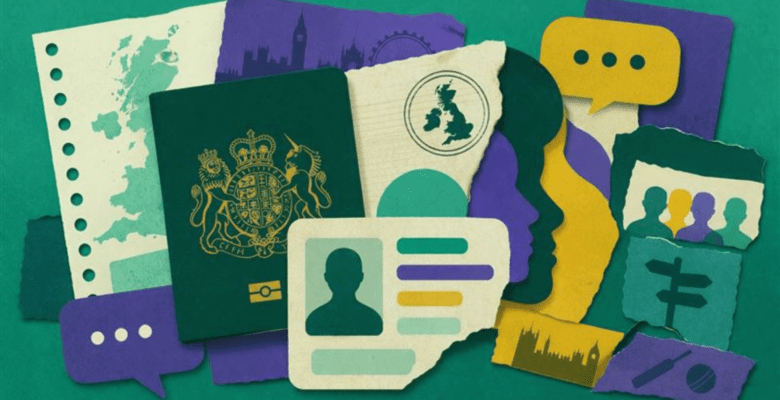
The weaponisation of this association may be one of the reasons that Black, Asian, and Mixed Heritage respondents were uncomfortable with identifying with Britishness. The racial terminology explored in our research project used markers that were cultural, geographical, political, and colour based. There was a sense that ethnicity is a more politically concrete category of definition, tied to nationality, heritage, and geography, with physical markers such as passports and birth certificates. Many survey respondents were aware of the double standard in which ethnicity is something that Black and Brown people have, but that is an unmarked category for the White majority population of the UK.
However, this distinction between ‘race’ and ‘ethnicity’ does not survive much scrutiny. ONS ethnicity categories used for data collection in the UK use visible skin colour, alongside country of origin (e.g. Black Caribbean). In other contexts, culture, language, religion, region, and continent are all used to identify and categorise racial and ethnic identity.
It is important to ensure that our language does not reify or uphold the false and dehumanising notion that there are real, scientific differences between ‘races’. What is real is racism; the effects of categorisation in which different communities who might share characteristics such as skin colour, facial features, heritage, where they were born or immigration status, can experience different outcomes based on that racialisation.