• Skip to primary navigation
  • Skip to main content
  • Skip to primary sidebar
Logo: Action For Race Equality

Action for Race Equality

Empowering Young People who are Black, Asian and of Mixed Heritage

  • Donate
  • ARE at Work
    • Programmes & Projects
      • Evidence into Action
      • Racial Terminology Project
      • Routes2Success
      • Stronger Futures
      • UPLIFT Programme
      • Windrush Justice Programme
    • Education
    • Employment
      • Ethnicity Pay Gap
      • A Journey to Inclusion
    • Criminal justice
      • Alliance for Police Accountability
      • The Gangs Matrix
    • Policy and Research
      • Donate
  • Who we ARE
    • Team
    • Trustees
    • Funders
    • Youth Action Network
    • History
  • ARE Community
    • Voluntary & Community organisations
    • Young People
    • Schools, colleges and training organisations
    • Collective Impact Partnerships
    • ARE as policy makers and researchers
    • Diversity & Inclusion Experts
    • Media
    • Businesses
  • Training & Consultancy
  • ARE Voices
  • Take action
    • Work with us
    • Youth Voice
  • Show Search
Hide Search
Home/ARE project update/A Numbers Game: Minority and Majority 
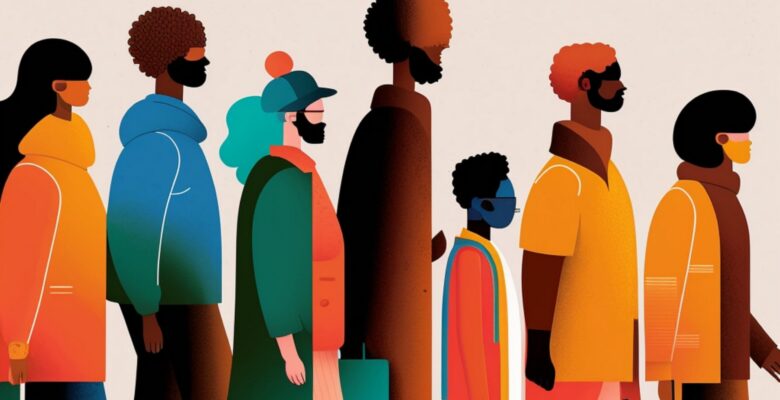
An illustration depicts a line of seven stylized figures of varying heights shown in profile, facing right against a plain, light beige background. The figures have different skin tones, hairstyles, and facial hair. They are dressed in various colorful garments, including a hooded jacket, a long coat, and a hat. The artwork uses a flat, minimalist style with clean lines and vibrant color gradients in shades of orange, teal, brown, and blue.

A Numbers Game: Minority and Majority 

This blog is part of Action for Race Equality’s Racial Terminology Project series, exploring how racial terminology is used, understood and debated across the UK today. 

  • LinkedIn
  • Bluesky
  • X
  • Instagram
  • Facebook

Estimated read time: 5 minutes

Several of the terms discussed in our research highlighted racialisation as a proportion. Ethnic or racialised ‘minorities’ in the UK in contrast to a White ‘majority’, reflecting the numbers of people identifying as such in the population.   

‘Ethnic Minority’ was used very frequently or fairly often by 48.1% of survey respondents. ‘Minoritised communities’ was used by a high proportion (c.40%) of respondents very frequently or fairly often.  Some respondents felt that ‘minority’ was a derogatory and value-laden term, while others felt that it correctly demonstrates the imbalance and the power and influence the White majority population in the UK has.

Many survey respondents felt that ‘Global Majority’ (used by 40% of survey respondents) was an empowering term that shifts the power dynamic. It was unfamiliar to the young people in the focus groups, and some felt it was too academic or disconnected from the realities of being a statistical minority in the UK.

Some participants also felt this to be a classed term – opaque and ‘posh’. Amongst survey respondents who listed a White ethnic identity, 62% used Global majority very frequently or fairly often, the most used term with this group.

In some focus groups, participants expressed the idea that the ‘majority’ status of global populations, such as Africans or Asians, was irrelevant in the context of the UK, and in fact, using the term global majority conceals the disparate material realities experienced here.

We may also recognise that power and resources still sit disproportionally with the global minority because of the legacies of colonialism and ask further questions about how we accurately reflect these structural power dynamics. Terms such as ‘global south’ and the ‘global north’ also circle as possible language choices.

One participant located a root cause of discrimination in the UK in the perception of Black and Brown people as a ‘threat’, and worried that the use of global majority simply adds to the already oversaturated landscape of alarmist White demographic ‘collapse’. 

Counter to this was the idea that expressing the ‘business case’ for the term global majority is one of the ways of convincing those with structural power to care; i.e. that addressing the racial disparities experienced by Black and Brown people in the UK might provide opportunities for economic growth and links with a global community. 

Others felt the benefits of expressing the common experience of those marginalised under systems of White supremacy to be a powerful tool for solidarity. Connecting our work for racial justice in the UK with global struggles against the legacies of colonialism, reparations, and ongoing violence in Black and Brown majority countries feels appropriate in an age of worldwide internet and social media systems.

Though the global majority was often felt to be a way to tap into something bigger and more powerful, some felt that it elides the history of hierarchies within anti-racist organising, especially the prevalence of anti-Blackness. 

The term ‘minority’ generated similar and complex reactions in participants, often around the semantic slippage between the statistical and political realities it evokes; i.e. the statistical reality of being a minority in a white majority country, and the political reality of being necessarily disadvantaged by that minority status.

Many lauded the turn to ‘racially minoritised’ which they felt restored the context of systemic inequality to the term and implicates the deliberate creation and maintenance of inequalities. Similarly supported was ‘racialised minority’, putting the emphasis back on to the creation of racial categories, and not accepting their existence as natural.  

A counter to the statistical focus would be to emphasise that people might be minoritised and racialised in different cultural and political contexts. There was some discussion of whether being referred to as a ‘minority’, or ‘minoritised’ projected a victim status, or negative expectations.

Some took ownership of this ’minority status’ as one that correctly demonstrates the imbalance and the power and influence the White majority in the UK have. The idea that Black and Brown people might adopt and adjust labels like ’racially minoritised‘ or ’racialised minority’ for themselves, and not have it ascribed to them, was found to be empowering, though concessions were made to ‘ethnic minority’ for the sake of mainstream legibility.  

The statistical focus of ‘minority’ was felt to have some use, especially as a UN-recognised condition with a specific status. Some respondents emphasised the potential utility of using the language of the system that placed rights and responsibilities on the government. The wide geographical spread of our research also brought to the fore the fact that in some areas of the UK, Black and Brown people are not a minority, and their experiences of community, government, and disparities might differ accordingly. 

There was an interest in the operational weaknesses of the term ‘ethnic minority’, which is broad enough to encompass the experiences of groups that do not share a history of racialisation in the UK in the same way as Black and Brown people, for example, people from Eastern Europe. In some ways, ‘minority’ might be seen as a euphemism that conceals White supremacy, and especially in a legal context, can obfuscate and frustrate legislation that was created with the intention of securing rights and protections for Black and Brown people facing unequal treatment. 

Further reading:

Transforming Society ~ From minoritised to majority: Reclaiming EDI 

Minority Rule: Adventures in the Culture War – the instant Sunday Times bestseller: Ash Sarkar: Bloomsbury Publishing – Bloomsbury 

This blog is part of a series on our Racial Terminology Project. To find out more and access our guide, visit here.


←“White-Assumed”: The Scales of Colourism

A Connected Collective →

Read more blogs in this series…

An illustration of a diverse group of nine people from various ethnic backgrounds, shown from a top-down perspective. They are arranged in a circle, smiling and holding onto a large, thin wooden hoop. The group is set against a soft, abstract background of light green and blue diagonal gradients. The image conveys a sense of unity, community, and cooperation.

A Connected Collective 

27/04/2026
Read More
The image features a series of overlapping female silhouettes in profile, layered horizontally from left to right. The profiles transition through a gradient of skin tones, including deep brown, mahogany, terracotta, tan, and cream. A white square frame is placed over the right side of the composition, highlighting the intersection of three profiles. The entire group is set against a solid, bright teal background, creating a minimalist and graphic editorial style.

“White-Assumed”: The Scales of Colourism

27/04/2026
Read More
A magnifying glass with a black handle is centered over a collage of overlapping, colorful rectangular cards. A large, bold black question mark is visible through the magnifying lens, layered over faint, stylized silhouettes of two human profiles. The background cards feature a mix of solid colors, including teal, orange, and red, some with small circular icons in the corners. The overall style is a clean, modern digital illustration with a textured, paper-like finish.

A Question of Colour

27/04/2026
Read More
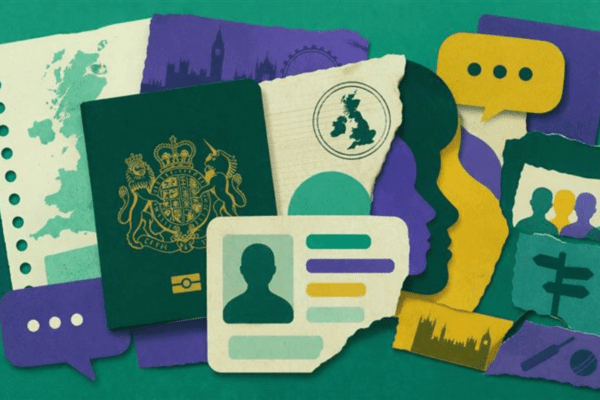
This stylized illustration explores themes of identity, citizenship, and travel within the United Kingdom, featuring a British passport to represent national identity and international movement, alongside ID card icons that suggest official documentation and personal identification; silhouettes of faces and chat bubbles convey communication and social interaction, while maps of the UK, the London skyline, and cricket imagery reinforce the British cultural and geographic context.

On Britishness 

27/04/2026
Read More
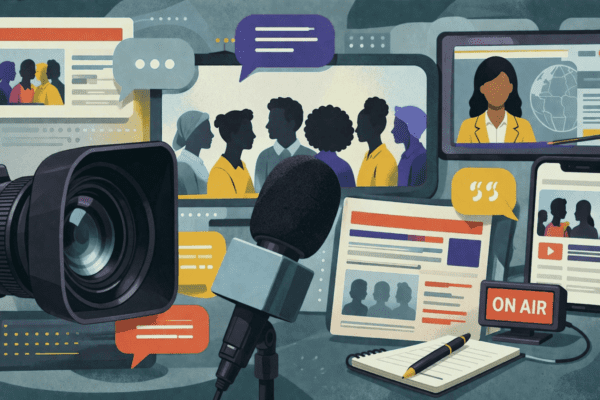
An abstract illustration representing modern journalism and media. A large professional video camera lens dominates the left side, while a microphone and notepad sit in the foreground. Various digital screens—including a tablet, smartphone, and monitors—display news segments, interviews with diverse people, and text-heavy articles. Floating speech bubbles and an "ON AIR" sign emphasize communication. The art style is flat and graphic with a muted color palette of blues, yellows, and oranges, symbolizing a connected, multi-platform news environment.

A Hosile Media Landscape 

27/04/2026
Read More
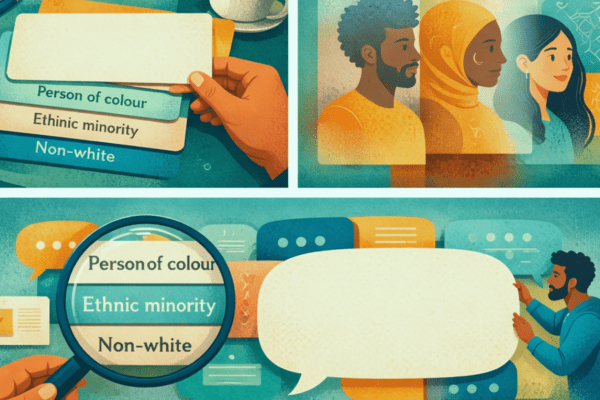
This illustration explores the complexity of racial identity labels. The top-left shows a hand holding a blank card over labels for "Person of colour," "Ethinic minority," and "Non-white." To the right, three individuals of diverse backgrounds are shown in profile. The bottom panel features a magnifying glass magnifying those same terms, while a man stands beside a large, empty speech bubble. The artwork reflects on how diverse groups are categorized and the ongoing dialogue surrounding inclusive language.

Diversity is a euphemism

27/04/2026
Read More
An illustration shows three diverse students collaborating at a desk filled with books, notebooks, and a laptop. A woman in the center speaks to a man on the right, while a woman on the left takes notes. Above them, colorful speech bubbles and a glowing lightbulb represent active communication and the sharing of ideas. The background is a soft teal with floating sticky notes, creating a vibrant atmosphere of teamwork, creativity, and academic focus.

Terminology as a tool

27/04/2026
Read More

Published on:
27/04/2026

Categories: ARE project update, ARE voices, Race Terminology Project

Primary Sidebar

Areas of work

  • News
  • Education
  • Employment
  • Criminal justice
  • ARE voices

Latest

  • Lives Not Knives: Breaking the cycle of exclusion, violence and limited opportunity
  • Serious About Youth: Helping young people access opportunities in construction
  • APA event brings together women at the centre of policing, racism and accountability debate 

Popular

  • The Hamilton Commission
  • Response to Public Accounts Committee on apprenticeships
  • Institutional racism, a leadership challenge
  • Is prison really a holiday camp?
  • EQUAL’s response to the MoJ

Explore more

Looking for information on a completed Action for Race Equality project? If you can’t find it on our website, let us know.

Services for business and not-for-profits.

Training and Consultancy

Footer

Registered Charity No 1056043
Company registration No 03203812

Action for Race Equality © 2026

  • Safeguarding Policy
  • Privacy Policy
  • Contact
  • News
  • Opportunity
  • Publications
We use cookies on our website to give you the most relevant experience by remembering your preferences and repeat visits. By clicking “Accept All”, you consent to the use of ALL the cookies. However, you may visit "Cookie Settings" to provide a controlled consent.
Cookie SettingsAccept All
Manage consent

Privacy Overview

We use cookies to improve your experience while you navigate through the website. Out of these, the cookies that are categorised as necessary are stored on your browser as they are essential for the working of basic functionalities of the website. We also use third-party cookies that help us analyse and understand how you use this website. These cookies will be stored in your browser only with your consent. You also have the option to opt-out of these cookies. But opting out of some of these cookies may affect your browsing experience.
Necessary
Always Enabled
Necessary cookies are absolutely essential for the website to function properly. These cookies ensure basic functionalities and security features of the website, anonymously.
CookieDurationDescription
cookielawinfo-checkbox-analytics11 monthsThis cookie is set by GDPR Cookie Consent plugin. The cookie is used to store the user consent for the cookies in the category "Analytics".
cookielawinfo-checkbox-functional11 monthsThe cookie is set by GDPR cookie consent to record the user consent for the cookies in the category "Functional".
cookielawinfo-checkbox-necessary11 monthsThis cookie is set by GDPR Cookie Consent plugin. The cookies is used to store the user consent for the cookies in the category "Necessary".
cookielawinfo-checkbox-others11 monthsThis cookie is set by GDPR Cookie Consent plugin. The cookie is used to store the user consent for the cookies in the category "Other.
cookielawinfo-checkbox-performance11 monthsThis cookie is set by GDPR Cookie Consent plugin. The cookie is used to store the user consent for the cookies in the category "Performance".
viewed_cookie_policy11 monthsThe cookie is set by the GDPR Cookie Consent plugin and is used to store whether or not user has consented to the use of cookies. It does not store any personal data.
Functional
Functional cookies help to perform certain functionalities like sharing the content of the website on social media platforms, collect feedbacks, and other third-party features.
Performance
Performance cookies are used to understand and analyze the key performance indexes of the website which helps in delivering a better user experience for the visitors.
Analytics
Analytical cookies are used to understand how visitors interact with the website. These cookies help provide information on metrics the number of visitors, bounce rate, traffic source, etc.
Advertisement
Advertisement cookies are used to provide visitors with relevant ads and marketing campaigns. These cookies track visitors across websites and collect information to provide customized ads.
Others
Other uncategorized cookies are those that are being analyzed and have not been classified into a category as yet.
SAVE & ACCEPT
Go to mobile version