• Skip to primary navigation
  • Skip to main content
  • Skip to primary sidebar
Logo: Action For Race Equality

Action for Race Equality

Empowering Young People who are Black, Asian and of Mixed Heritage

  • Donate
  • ARE at Work
    • Programmes & Projects
      • Evidence into Action
      • Racial Terminology Project
      • Routes2Success
      • Stronger Futures
      • UPLIFT Programme
      • Windrush Justice Programme
    • Education
    • Employment
      • Ethnicity Pay Gap
      • A Journey to Inclusion
    • Criminal justice
      • Alliance for Police Accountability
      • The Gangs Matrix
    • Policy and Research
      • Donate
  • Who we ARE
    • Team
    • Trustees
    • Funders
    • Youth Action Network
    • History
  • ARE Community
    • Voluntary & Community organisations
    • Young People
    • Schools, colleges and training organisations
    • Collective Impact Partnerships
    • ARE as policy makers and researchers
    • Diversity & Inclusion Experts
    • Media
    • Businesses
  • Training & Consultancy
  • ARE Voices
  • Take action
    • Work with us
    • Youth Voice
  • Show Search
Hide Search
Home/ARE project update/A Hosile Media Landscape 
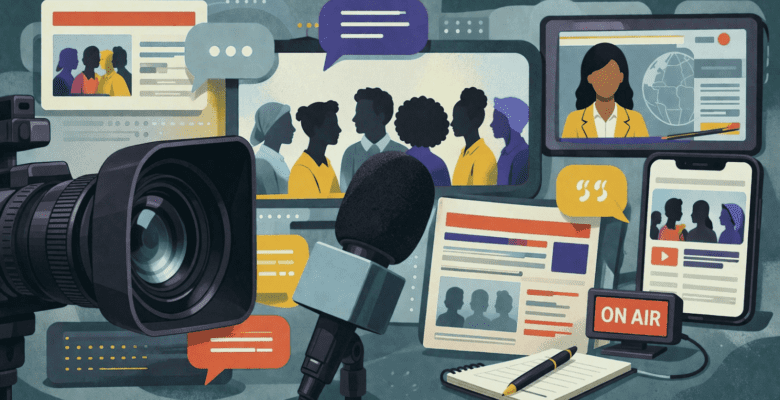
An abstract illustration representing modern journalism and media. A large professional video camera lens dominates the left side, while a microphone and notepad sit in the foreground. Various digital screens—including a tablet, smartphone, and monitors—display news segments, interviews with diverse people, and text-heavy articles. Floating speech bubbles and an "ON AIR" sign emphasize communication. The art style is flat and graphic with a muted color palette of blues, yellows, and oranges, symbolizing a connected, multi-platform news environment.

A Hosile Media Landscape 

This blog is part of Action for Race Equality’s Racial Terminology Project series, exploring how racial terminology is used, understood and debated across the UK today. 

  • LinkedIn
  • Bluesky
  • X
  • Instagram
  • Facebook

Estimated read time: 3 minutes

The media landscape plays a central role in shaping narratives around race equality. As part of our research, we examined several case studies of recent news stories on race and racism with research participants in order to explore the acceptability of terminology.

Case study: Zarah Sultana

We looked firstly at a Good Morning Britain interview in August 2024 with Zarah Sultana, the Independent MP for Coventry South, during which she made the case for the racist riots that month to be called ‘racist’, and specifically Islamophobic, citing the direct targeting of mosques. 

She experienced pushback from presenters about her focus on terminology. At the time, the government had used the language of ‘far-right thuggery’, and she was repeatedly questioned as to why specific language mattered. 

Zarah Sultana’s Good Morning Britain interview exposed some of how retreating from the conversation about racial terminology might allow others to dictate the terms we use. 

Case study: Marieha Hussain and Frank Hester

Through the contrasting examples of 2023/24 news stories of Marieha Hussain and Frank Hester, focus group participants were able to discuss the differences between offensive and illegal terminology, and explore varied views on ‘free speech’.

Most saw Marieha Hussain’s use of a placard depicting coconuts and the faces of some Conservative politicians as the expression of an acceptable criticism and a political statement. Several interesting discussions were had in the focus groups around the use of the term ‘coconut’ in Black and Brown communities; the history of ‘Uncle Toms’ and ‘race traitors’ tied up in colonial histories, and the benefits of proximity to Whiteness in relation to ‘Whitewashing’ and ‘cultural authenticity’.  

Young people resonated with and were interested in the complex history of the ways in which Black and Brown individuals have been made complicit in the harming of their communities by colonialism. They also saw Frank Hester’s appalling comments about Diane Abbott, and his incitement to violence against all Black people as clearly racist, wrong, and illegal. 

Hussain’s placard had no words; it was a visual representation of criticism of Brown politicians and their politics from a Brown person. Frank Hester’s comments were an incitement to violence from a rich White political donor against an opposition politician who was a Black woman. The fact that charges were brought against Marieha and not Frank demonstrates a gap in the way in which racial terminology is policed in the UK. 

Who holds the power?

There is also a distinction to be made in these media examples about the direction in which power operates. Language used amongst Black and Brown communities to question, challenge, and even discriminate is different from the language used in the service of the structural power imbalance between White supremacy and those who are victims of White supremacy. Uses of racial terminology in the media must be responsible and aware of the power language holds.

The language choices journalists make in discussing racism and portraying communities of colour in the news media rarely reflect the terms preferred by those discussed.

Terminology around migration and class often intersect in important ways with this landscape. The proscription of Palestine Action as a terrorist group alongside the policing of the description of what is happening in Palestine as a ‘plausible genocide’ is a key example of how terminology has become an important battleground. The media and political discourse actively define, demarcate, limit, and control language and acceptable ways to discuss and dissent. 

This blog is part of a series on our Racial Terminology Project. To find out more and access our toolkit, visit here.
←Diversity is a euphemism
On Britishness →

Read more blogs in this series…

An illustration of a diverse group of nine people from various ethnic backgrounds, shown from a top-down perspective. They are arranged in a circle, smiling and holding onto a large, thin wooden hoop. The group is set against a soft, abstract background of light green and blue diagonal gradients. The image conveys a sense of unity, community, and cooperation.

A Connected Collective 

27/04/2026
Read More
An illustration depicts a line of seven stylized figures of varying heights shown in profile, facing right against a plain, light beige background. The figures have different skin tones, hairstyles, and facial hair. They are dressed in various colorful garments, including a hooded jacket, a long coat, and a hat. The artwork uses a flat, minimalist style with clean lines and vibrant color gradients in shades of orange, teal, brown, and blue.

A Numbers Game: Minority and Majority 

27/04/2026
Read More
The image features a series of overlapping female silhouettes in profile, layered horizontally from left to right. The profiles transition through a gradient of skin tones, including deep brown, mahogany, terracotta, tan, and cream. A white square frame is placed over the right side of the composition, highlighting the intersection of three profiles. The entire group is set against a solid, bright teal background, creating a minimalist and graphic editorial style.

“White-Assumed”: The Scales of Colourism

27/04/2026
Read More
A magnifying glass with a black handle is centered over a collage of overlapping, colorful rectangular cards. A large, bold black question mark is visible through the magnifying lens, layered over faint, stylized silhouettes of two human profiles. The background cards feature a mix of solid colors, including teal, orange, and red, some with small circular icons in the corners. The overall style is a clean, modern digital illustration with a textured, paper-like finish.

A Question of Colour

27/04/2026
Read More
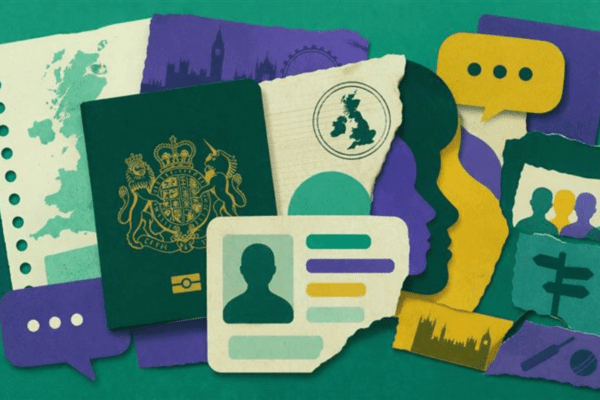
This stylized illustration explores themes of identity, citizenship, and travel within the United Kingdom, featuring a British passport to represent national identity and international movement, alongside ID card icons that suggest official documentation and personal identification; silhouettes of faces and chat bubbles convey communication and social interaction, while maps of the UK, the London skyline, and cricket imagery reinforce the British cultural and geographic context.

On Britishness 

27/04/2026
Read More
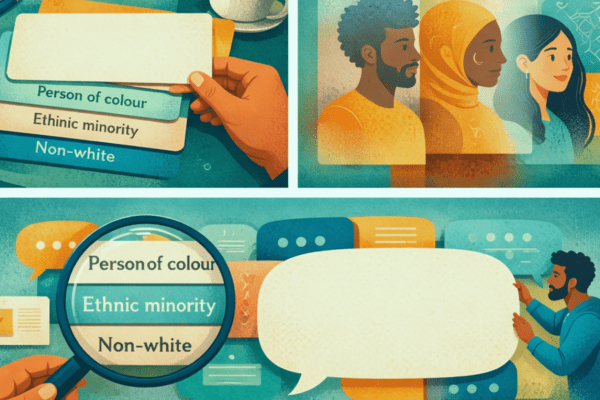
This illustration explores the complexity of racial identity labels. The top-left shows a hand holding a blank card over labels for "Person of colour," "Ethinic minority," and "Non-white." To the right, three individuals of diverse backgrounds are shown in profile. The bottom panel features a magnifying glass magnifying those same terms, while a man stands beside a large, empty speech bubble. The artwork reflects on how diverse groups are categorized and the ongoing dialogue surrounding inclusive language.

Diversity is a euphemism

27/04/2026
Read More

Published on:
27/04/2026

Categories: ARE project update, ARE voices, Race Terminology Project

Primary Sidebar

Areas of work

  • News
  • Education
  • Employment
  • Criminal justice
  • ARE voices

Latest

  • Lives Not Knives: Breaking the cycle of exclusion, violence and limited opportunity
  • Serious About Youth: Helping young people access opportunities in construction
  • APA event brings together women at the centre of policing, racism and accountability debate 

Popular

  • The Hamilton Commission
  • Response to Public Accounts Committee on apprenticeships
  • Institutional racism, a leadership challenge
  • Is prison really a holiday camp?
  • EQUAL’s response to the MoJ

Explore more

Looking for information on a completed Action for Race Equality project? If you can’t find it on our website, let us know.

Services for business and not-for-profits.

Training and Consultancy

Footer

Registered Charity No 1056043
Company registration No 03203812

Action for Race Equality © 2026

  • Safeguarding Policy
  • Privacy Policy
  • Contact
  • News
  • Opportunity
  • Publications
We use cookies on our website to give you the most relevant experience by remembering your preferences and repeat visits. By clicking “Accept All”, you consent to the use of ALL the cookies. However, you may visit "Cookie Settings" to provide a controlled consent.
Cookie SettingsAccept All
Manage consent

Privacy Overview

We use cookies to improve your experience while you navigate through the website. Out of these, the cookies that are categorised as necessary are stored on your browser as they are essential for the working of basic functionalities of the website. We also use third-party cookies that help us analyse and understand how you use this website. These cookies will be stored in your browser only with your consent. You also have the option to opt-out of these cookies. But opting out of some of these cookies may affect your browsing experience.
Necessary
Always Enabled
Necessary cookies are absolutely essential for the website to function properly. These cookies ensure basic functionalities and security features of the website, anonymously.
CookieDurationDescription
cookielawinfo-checkbox-analytics11 monthsThis cookie is set by GDPR Cookie Consent plugin. The cookie is used to store the user consent for the cookies in the category "Analytics".
cookielawinfo-checkbox-functional11 monthsThe cookie is set by GDPR cookie consent to record the user consent for the cookies in the category "Functional".
cookielawinfo-checkbox-necessary11 monthsThis cookie is set by GDPR Cookie Consent plugin. The cookies is used to store the user consent for the cookies in the category "Necessary".
cookielawinfo-checkbox-others11 monthsThis cookie is set by GDPR Cookie Consent plugin. The cookie is used to store the user consent for the cookies in the category "Other.
cookielawinfo-checkbox-performance11 monthsThis cookie is set by GDPR Cookie Consent plugin. The cookie is used to store the user consent for the cookies in the category "Performance".
viewed_cookie_policy11 monthsThe cookie is set by the GDPR Cookie Consent plugin and is used to store whether or not user has consented to the use of cookies. It does not store any personal data.
Functional
Functional cookies help to perform certain functionalities like sharing the content of the website on social media platforms, collect feedbacks, and other third-party features.
Performance
Performance cookies are used to understand and analyze the key performance indexes of the website which helps in delivering a better user experience for the visitors.
Analytics
Analytical cookies are used to understand how visitors interact with the website. These cookies help provide information on metrics the number of visitors, bounce rate, traffic source, etc.
Advertisement
Advertisement cookies are used to provide visitors with relevant ads and marketing campaigns. These cookies track visitors across websites and collect information to provide customized ads.
Others
Other uncategorized cookies are those that are being analyzed and have not been classified into a category as yet.
SAVE & ACCEPT
Go to mobile version