
This blog is part of Action for Race Equality’s Racial Terminology Project series, exploring how racial terminology is used, understood and debated across the UK today.
CONTENT NOTE: This blog explores racial terms which some may find offensive.
Estimated read time: 5 minutes
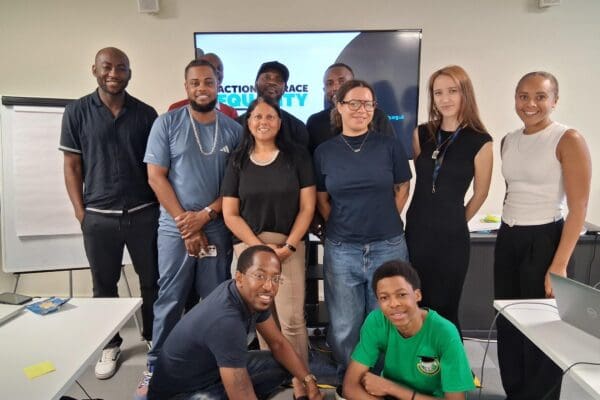
Young people we spoke to as part of our project were cautiously inquisitive about how different colour assignations emerged over time, and the differing acceptability of terms to describe people that are based in colours.
It’s kind of, I feel like it might sound ignorant, but I don’t mean to come across that way. We know how that we assign colour to like Black and Brown people, but then when it’s when you say yellow for Asian or like red for a native person, it’s considered racist. And I don’t understand why colour for a certain group of people would be considered appropriate, and then for another group of people, it’s not appropriate?”
– Young People Focus Group participant
Young people and facilitators debated whether the difference lies in which terms groups use for themselves, and which terms are used against them as derogatory slurs. The legislative legacies of the term ‘colored/coloured’, and its specific usage in the history of segregation in Jim Crow America, apartheid South Africa, and 1980s England, have also provided opportunities to contextualise racial terminology, where young people felt underserved and lacking in their own education.
There was also some interesting discussion around the semantic crossover of terms like ‘Black’ and ‘dark’ in popular culture, from ‘Black Friday’ discounts to depictions of evil in fiction. Young people were less accepting of the perhaps arbitrary distinction between these uses of the same word in different contexts.
Respondents were conscious of the ways in which referring to Black people as ‘Blacks’ in the plural often indicated a devaluing of their humanity, and a sense of collectivisation originating in racist ideas of difference.
Political Blackness
There was a strong understanding of ‘Black’ as a separate and independent socio-political identity, highlighting an awareness of the differences that anti-Blackness contains in comparison to racism in general. Though some survey respondents spoke about ‘political Blackness’, young people in the focus groups were mostly unfamiliar with the term. However, some did demonstrate an appreciation of its historical power and the potential solidarity it might create, whilst recognising that in breaking down that term we may have reached a more varied and nuanced understanding of racialisation.
Those with living memory of using ‘political Blackness’ were passionate about the ways in which Whiteness appears to have the privilege of being uncomplicated.
Using ‘Black’ as a catch all for everyone who did not fit into ‘Whiteness’ was a recognition of the ways in which ‘White’ holds the politics and the power, and the need to name ‘the other’. There was a complementary understanding of Black as a term denoting power and being used to reclaim the narrative of marginalisation.
‘Brown’ and ‘Muslim‘
Alongside the prevalence of the use of ‘Black’, many participants used ‘Brown’ to refer to their skin colour as a way of identifying themselves, and as a marker of the shared experiences of racism people with Black and Brown skin might have.
Muslim respondents spoke on the ways in which Brownness and Muslimness are often conflated, and that Islamophobia can often be directed against Brown people who are not Muslim.
The unadopted definition of Islamophobia proposed by the All-Party Parliamentary Group (APPG) on British Muslims acknowledges this, describing it as “rooted in racism and is a type of racism that targets expressions of Muslimness or perceived Muslimness”. This definition is widely endorsed across Muslim communities, political parties and civil society.
Focus group participants viewed this definition as useful in describing how racism operates in conflating skin colour, culture, and religion, especially around the terms ’Brown’ and ’Muslim’. Participants were also vocal about the erasure of Muslims who did not identify as Brown, especially White British Muslims.
There was also concern around the institutionalisation of Islamophobia, and the erasure of civil liberties in terms of the freedom to practice religion, but also talk to the ways in which Brownness and visual racialised identities can lead individuals to experience types of discrimination that do not align with the realities of their identities.
Racial terminology and definitions can be seen here to not only describe the material and legislative conditions of discrimination, but also to proscribe what ’counts’ as racism.
People of Colour
‘People of Colour’ was used by a high proportion (c.40%) of respondents to our survey very frequently or fairly often. Despite this, respondents often had contradictory opinions about its use. Many respondents felt that it was an American term, and too close to ‘colored people’, which was historically a slur. Several raised issue with the ways in which it positions Whiteness as the norm or the centre, a criticism shared with the term ‘non-White’.
One young person felt that context was key; in some contexts, People of Colour felt very insulting, and on an individual basis they would prefer to be identified as ‘Black’ or ‘Mixed’. In this regard, it might be seen as eroding differences between specific groups, a criticism levelled at many of the collective terms we explored. One respondent expressed fatigue at continuing to use and adapt to new and longer terms, and shared relief that they have started using ‘Black and Brown staff’ in their organisation, and that it felt ‘just quite real’.
In other contexts, the umbrella of People of Colour might encapsulate communities across different types of racialisation. This term gained traction in the idea of representing a collective, and marking space that does exclude people who do not experience racialisation based on skin colour. Some participants were comforted by the roots of the term, coming from queer, Black, Brown, feminist circles, positioning it as a term of solidarity between people for the specific aim of working together against racism.
Many respondents railed against the idea that only some people ‘have colour’ and expressed variations of the idea that all people have or are ‘a colour’. Similarly, some expressed distaste at the term non-White, as something that prioritises and centres the experiences of White people.
Some respondents felt that ‘non-White’ encompassed the shared experiences of those who are racialised in White-majority society.
This blog is part of a series on our Racial Terminology Project. To find out more and access our toolkit, visit here.