
• Skip to primary navigation
  • Skip to main content
  • Skip to primary sidebar
Action for Race Equality

Action for Race Equality

Empowering Young People who are Black, Asian and of Mixed Heritage

  • Donate
  • ARE at Work
    • Programmes & Projects
      • Building Ethnic Diversity in the Youth Employability Sector
      • Evidence into Action
      • The Graduate Connector Programme
      • Routes2Success
      • Stronger Futures
      • UPLIFT Programme
      • Windrush Justice Programme
    • Education
    • Employment
      • Ethnicity Pay Gap
      • A Journey to Inclusion
    • Criminal justice
      • Alliance for Police Accountability
      • The Gangs Matrix
    • Policy and Research
      • Donate
  • Who we ARE
    • Team
    • Trustees
    • Funders
    • Youth Action Network
    • History
  • ARE Community
    • Voluntary & Community organisations
    • Young People
    • Schools, colleges and training organisations
    • Collective Impact Partnerships
    • ARE as policy makers and researchers
    • Diversity & Inclusion Experts
    • Media
    • Businesses
  • Training & Consultancy
  • ARE Voices
  • Take action
    • Work with us
    • Youth Voice
  • Show Search
Hide Search
Home/apprenticeships/The Doomsday Clock: Why racism is moving us closer to Midnight?
Retro clock at 11.59.

The Doomsday Clock: Why racism is moving us closer to Midnight?

Every New Year I keep an eye on the Doomsday Clock by the Bulletin of Atomic Scientists 2026 Doomsday Clock Statement – Bulletin of the Atomic Scientists.

The Bulletin was set up in 1945 by Albert Einstein, J. Robert Oppenheimer, and the University of Chicago scientists who helped develop the first atomic weapons for The Manhattan Project. Two years later, in 1947, they came up with the Doomsday Clock; which tracks the proliferation of technologies, conflicts and other stressors such as biological threats, climate change to assess global vulnerability. 

If the apocalypse or a nuclear attack is considered to happen at midnight, the time on the clock illustrates how close we are to that event taking place.

The threats assessed now include environmental disaster, biohazard and global wars. Since 2010 we have moved increasingly close to midnight.  In the last update, released recently (27 January 2026), it edged ever closer to global catastrophe at 85 seconds…
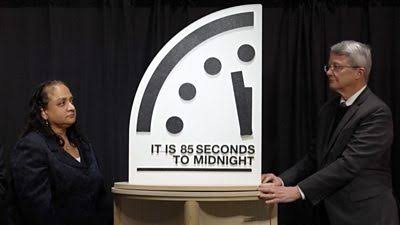
The technology for all out war has been with us since 1945 but the other factors that matter are the temperature for war, mood of the leaders and compulsion to fight. As the Bulletin says many major world leaders have become more aggressive – at home and abroad. For example, in the US we see Trump’s actions causing major crisis in his own cities like Minneapolis and Maine.

The imminent ending of agreements to stop nuclear arms proliferation is happening at a time when new agreements seem uncertain.

The failure to find resolution to the climate crisis, which the US is not seeing as a priority, and in which the COP (Conference of the Parties) meetings have failed to address fossil fuel consumption is another driver for the statistic.  Asian, African, and South American countries are the most likely to suffer the harms of climate change while the west is better placed to mitigate its effects.

Sadly, one aspect of those matters, racism, appears to be getting worse on a global scale. It is not just a feeling or sense of concern as we are seeing an increase in extremist parties making political footholds globally; this view is also supported by sources such as the United Nations, UNESCO and Amnesty International amongst others.

UNESCO stat

According to UNESCO’s newly launched Global Outlook on Racism and Discrimination, compiled using AI analysis of world news, race accounts for 38% of reported discrimination cases globally, followed by sex and gender (33%) and ethnicity (20%).

Alarmingly, 18% of cases involve physical attacks, underscoring the violence and harm many face daily. Systematic oppression, tied to societal and institutional structures, makes up 25% of incidents.

Dr Ashwini KP, the Human Rights Council’s Special Rapporteur (SR) on contemporary forms of racism, racial discrimination, xenophobia, and related intolerance, presented three reports during the Interactive Dialogue held on 3 July 2025, at the 27th and 28th meetings of the 59th session of the Human Rights Council.

  • The first Report focused on her official visit to Brazil, highlighting systemic racism and the urgent need for reparative justice for Afro-Brazilian communities, Indigenous peoples, and other marginalised groups affected by historical injustices.
  • The second Report explored intersectionality as a crucial framework for achieving racial justice. Evidence was drawn globally from almost every member state of marginalised communities or state endorsed systems of racism.  Dr Ashwini emphasised that tackling racism requires understanding its intersection with other forms of discrimination, including gender, disability, and migration status, and called for this approach to be integrated into laws and policies.
  • The third Report criticised the glorification of Nazism as a legal and moral imperative, documenting the rise of neo-Nazi ideologies and urging Member States to strengthen legal measures to combat such extremist views.

As well as providing evidence to the Human Rights Council, Amnesty International has separately published ‘The Digital Border: Migration, Technology, Inequality’   documenting the increasing use of ‘racist’ technologies at borders which exacerbate underlying racial, economic, and social inequalities at borders and beyond.

 Migrant workers and others with insecure citizenship status are often subject to the same forms of digitally enabled surveillance, monitoring, and exploitation as asylum seekers and refugees, and are similarly targeted by these technologies because of their inability to opt out or seek redress from harm. These technologies are often designed primarily by for profit organisations who are not concerned with human rights or the ethics of increased drone surveillance or biometric sensors and are poorly regulated, if at all, by governments.

Globally, a concern is people are being manipulated to operate for and by racist systems, ignore increasing problems and endorse governmental structures of oppression in order to increase these threats.  Others, find it easier to turn a blind eye to these activities.  

Those doing the manipulation do so for many reasons, often local power or personal power; or sell war products; or control of land and other natural resources.  Many leaders rather than minimising our differences, focusing on our similarities and finding ways to reduce conflict are ramping up polarities for personal gain. It strikes me that many of those pursuing these causes feel invincible when they do these things.

At a very strategic level the Doomsday Clock tells us otherwise. The truth is when we allow people to harden, to be aggressive and in practice to make arguments of oppression or the case for one ethnicity or race or person over another, for low tolerance of diversity and hostile environments for the ‘other’ we do not become more invincible. We become at greater risk; all of us – each and every one.

This is why ending racism is important, not just for those of use who suffer it, but for all of us. This is why we all need to be active anti-racists.

HRC59: Intersectionality from a Racial Justice Perspective

Intersectionality from a racial justice perspective: Submission to the UN Special Rapporteur on Contemporary Forms of Racism, Racial Discrimination, Xenophobia and Related Intolerance – Amnesty International


Seema portrait image

Seema Manchanda

Chair of ARE’s Board of Trustees


    More like this…

    New scorecard sets out five urgent priorities for the Windrush Commissioner

    African American man smiling and working remotely from home using a laptop and digital tablet.

    We’re Hiring: Policy Officer (Alliance for Police Accountability)

    Action for Race Equality unveils new campaign film ‘Roots’

    Published on:
    16/02/2026

    Categories: apprenticeships, ARE comment, ARE voicesTags: ARE voices, blog, charity, community organisation, criminal justice, policing, spotlight, young people

    Primary Sidebar

    Areas of work

    • News
    • Education
    • Employment
    • Criminal justice
    • ARE voices

    Latest

    • The Doomsday Clock: Why racism is moving us closer to Midnight?
    • New scorecard sets out five urgent priorities for the Windrush Commissioner
    • We’re Hiring: Policy Officer (Alliance for Police Accountability)

    Popular

    • The Hamilton Commission
    • Response to Public Accounts Committee on apprenticeships
    • Institutional racism, a leadership challenge
    • Is prison really a holiday camp?
    • EQUAL’s response to the MoJ

    Explore more

    Looking for information on a completed Action for Race Equality project? If you can’t find it on our website, let us know.

    Services for business and not-for-profits.

    Training and Consultancy

    Footer

    Registered Charity No 1056043
    Company registration No 03203812

    Action for Race Equality © 2026

    • Privacy Policy
    • Safeguarding Policy
    • Contact
    • News
    • Opportunity
    • Publications
    We use cookies on our website to give you the most relevant experience by remembering your preferences and repeat visits. By clicking “Accept All”, you consent to the use of ALL the cookies. However, you may visit "Cookie Settings" to provide a controlled consent.
    Cookie SettingsAccept All
    Manage consent

    Privacy Overview

    We use cookies to improve your experience while you navigate through the website. Out of these, the cookies that are categorised as necessary are stored on your browser as they are essential for the working of basic functionalities of the website. We also use third-party cookies that help us analyse and understand how you use this website. These cookies will be stored in your browser only with your consent. You also have the option to opt-out of these cookies. But opting out of some of these cookies may affect your browsing experience.
    Necessary
    Always Enabled
    Necessary cookies are absolutely essential for the website to function properly. These cookies ensure basic functionalities and security features of the website, anonymously.
    CookieDurationDescription
    cookielawinfo-checkbox-analytics11 monthsThis cookie is set by GDPR Cookie Consent plugin. The cookie is used to store the user consent for the cookies in the category "Analytics".
    cookielawinfo-checkbox-functional11 monthsThe cookie is set by GDPR cookie consent to record the user consent for the cookies in the category "Functional".
    cookielawinfo-checkbox-necessary11 monthsThis cookie is set by GDPR Cookie Consent plugin. The cookies is used to store the user consent for the cookies in the category "Necessary".
    cookielawinfo-checkbox-others11 monthsThis cookie is set by GDPR Cookie Consent plugin. The cookie is used to store the user consent for the cookies in the category "Other.
    cookielawinfo-checkbox-performance11 monthsThis cookie is set by GDPR Cookie Consent plugin. The cookie is used to store the user consent for the cookies in the category "Performance".
    viewed_cookie_policy11 monthsThe cookie is set by the GDPR Cookie Consent plugin and is used to store whether or not user has consented to the use of cookies. It does not store any personal data.
    Functional
    Functional cookies help to perform certain functionalities like sharing the content of the website on social media platforms, collect feedbacks, and other third-party features.
    Performance
    Performance cookies are used to understand and analyze the key performance indexes of the website which helps in delivering a better user experience for the visitors.
    Analytics
    Analytical cookies are used to understand how visitors interact with the website. These cookies help provide information on metrics the number of visitors, bounce rate, traffic source, etc.
    Advertisement
    Advertisement cookies are used to provide visitors with relevant ads and marketing campaigns. These cookies track visitors across websites and collect information to provide customized ads.
    Others
    Other uncategorized cookies are those that are being analyzed and have not been classified into a category as yet.
    SAVE & ACCEPT
    Go to mobile version