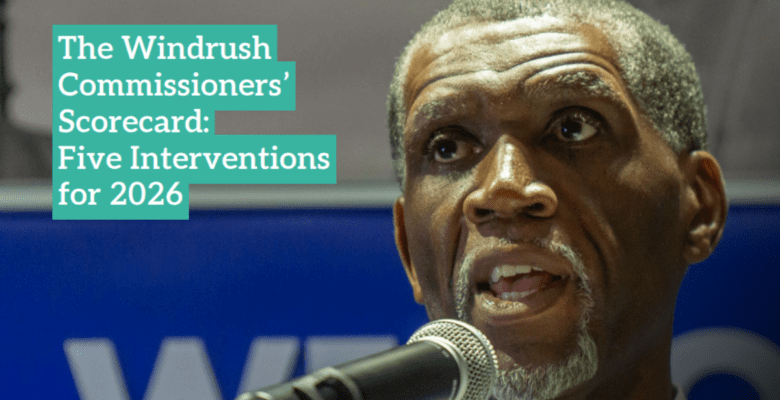
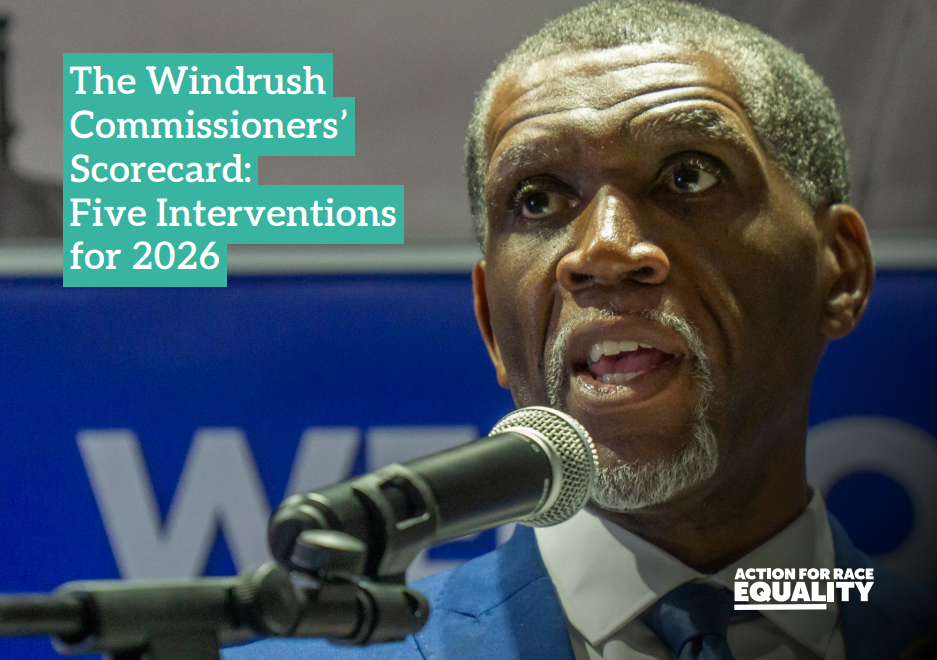
Action for Race Equality has published the Windrush Commissioners’ Scorecard, setting out five priority interventions Reverend Clive Foster MBE, the Windrush Commissioner, should focus on in 2026 to deliver justice for people affected by the Home Office Windrush scandal.
The scorecard is designed as an accountability tool. It identifies the actions that would have the greatest impact on fairer compensation and meaningful redress, providing a clear framework for tracking progress during the Commissioner’s first full year in post.
Why this scorecard is needed
Seven years after the Home Office Windrush scandal, many survivors are still without status, compensation or closure.Two thirds (66%) of claimants have been denied compensation, and over 6,000 eligible claims have received zero offers. At the same time, evidence shows that claimants with legal representation receive significantly higher awards, yet Windrush remains the only major state injustice without funded legal representation or a statutory compensation scheme.
With the Commissioner’s term limited to three years, it is critical that his office focuses on the interventions that will deliver the greatest change.
The scorecard responds to this by:
- Outlining key areas where urgent reform is needed most
- Shifting focus from high-level commitments to measurable action
- Providing a shared reference point for the Windrush Commissioner, the Home Office and other stakeholders
Five key interventions for 2026
The scorecard sets out five interventions the Commissioner should prioritise in 2026:
1. Fund legal representation
Research by JUSTICE shows that claimants with legal support receive, on average, £83,200 in compensation, compared with just £11,400 for those without. Yet the Windrush scandal is the only major state injustice where survivors do not have access to funded legal representation, and where the compensation scheme is non-statutory. Other schemes, such as the Infected Blood Compensation Authority and the Post Office Horizon redress scheme, have already put in place models for free, independent legal support. The scorecard calls on the Commissioner to press for publicly funded, independent legal representation for all Windrush claimants, so that survivors can gather evidence, understand complex case files and challenge unfair decisions on an equal footing.
2. Remove the MP mechanism
At present, Windrush survivors who want to complain about the compensation scheme or a decision by the Adjudicator’s Office must rely on their local MP to refer their case to the Parliamentary and Health Service Ombudsman. Access to justice therefore becomes a lottery, dependent on whether an MP is willing and able to act. The scorecard recommends that the Commissioner work to abolish this MP mechanism and support the creation of a fair, independent appeals process, overseen by an independent statutory body, in line with how other state injustices are handled.
3. End zero offers
The application success rate for the Windrush Compensation Scheme remains low, with two thirds of claimants denied compensation and more than 6,000 eligible claims receiving nil awards. While the Home Office has suggested misinformation is driving some ineligible claims, advocates on ARE’s Windrush Justice Programme highlight deeper problems: a highly complex scheme, strict evidence requirements and no guaranteed access to legal advice. The scorecard urges the Commissioner to ensure his review into zero offers tackles all these issues and to push for a time-bound Home Office action plan to reduce nil awards, alongside a new independent review route for people who applied without legal support or accepted low offers.
4. Strengthen the advocacy ecosystem
Through the Windrush Justice Programme, ARE has seen how trusted, community-based organisations are critical to helping survivors understand their rights and complete claims. The government’s £1.5 million Windrush Compensation Advocacy Support Fund is welcome, but some groups have raised concerns about its application process, assessment criteria and the uneven availability of advocacy in some regions. The scorecard calls on the Commissioner to work with the fund’s team to ensure it meets the needs of grassroots organisations and survivors, increase support in areas with little or no advocacy provision, and align the fund with the Windrush Community Engagement Fund so that awareness-raising is matched by practical support.
5. Truth before reconciliation
Survivors and advocates have expressed concern that reconciliation events could be rushed and used to declare the Windrush issue “closed” without securing full accountability. The scorecard argues that any reconciliation programme must first centre truth – creating space for survivors to share the impact of the scandal on their lives, and for government to acknowledge institutional failings. The Commissioner is urged to co-design any reconciliation process with survivors and advocates so that it becomes an opportunity for accountability and further reform, not a closing chapter.
We will continue to work with the Commissioner and offer our support to deliver on these interventions across 2026.
The full Windrush Commissioners’ Scorecard: Five Interventions for 2026 is available to download below.
About the Windrush Justice Programme
Action for Race Equality’s Windrush Justice Programme supports over 30 advocacy groups across the UK, providing capacity building and funding to help Windrush survivors access the compensation and documentation they deserve.
For more information about our Windrush Justice Programme, please contact Windrush Policy Manager, Kimberly McIntosh.
For media enquiries, please contact us: Hello@actionforraceequality.org.uk