This blog is part of Action for Race Equality’s Racial Terminology Project series, exploring how racial terminology is used, understood and debated across the UK today.
Estimated read time: 5 minutes
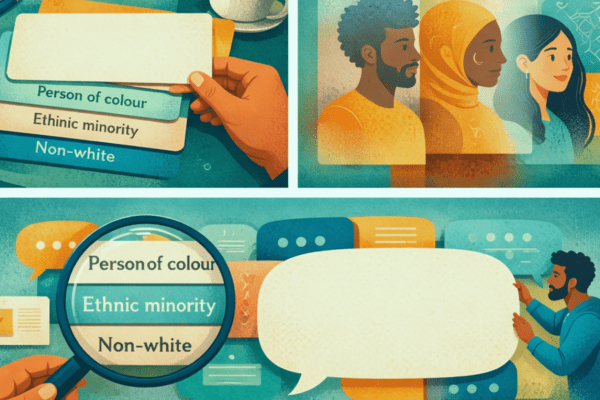
Several of the terms discussed in our research highlighted racialisation as a proportion. Ethnic or racialised ‘minorities’ in the UK in contrast to a White ‘majority’, reflecting the numbers of people identifying as such in the population.
‘Ethnic Minority’ was used very frequently or fairly often by 48.1% of survey respondents. ‘Minoritised communities’ was used by a high proportion (c.40%) of respondents very frequently or fairly often. Some respondents felt that ‘minority’ was a derogatory and value-laden term, while others felt that it correctly demonstrates the imbalance and the power and influence the White majority population in the UK has.
Many survey respondents felt that ‘Global Majority’ (used by 40% of survey respondents) was an empowering term that shifts the power dynamic. It was unfamiliar to the young people in the focus groups, and some felt it was too academic or disconnected from the realities of being a statistical minority in the UK.
Some participants also felt this to be a classed term – opaque and ‘posh’. Amongst survey respondents who listed a White ethnic identity, 62% used Global majority very frequently or fairly often, the most used term with this group.
In some focus groups, participants expressed the idea that the ‘majority’ status of global populations, such as Africans or Asians, was irrelevant in the context of the UK, and in fact, using the term global majority conceals the disparate material realities experienced here.
We may also recognise that power and resources still sit disproportionally with the global minority because of the legacies of colonialism and ask further questions about how we accurately reflect these structural power dynamics. Terms such as ‘global south’ and the ‘global north’ also circle as possible language choices.
One participant located a root cause of discrimination in the UK in the perception of Black and Brown people as a ‘threat’, and worried that the use of global majority simply adds to the already oversaturated landscape of alarmist White demographic ‘collapse’.
Counter to this was the idea that expressing the ‘business case’ for the term global majority is one of the ways of convincing those with structural power to care; i.e. that addressing the racial disparities experienced by Black and Brown people in the UK might provide opportunities for economic growth and links with a global community.
Others felt the benefits of expressing the common experience of those marginalised under systems of White supremacy to be a powerful tool for solidarity. Connecting our work for racial justice in the UK with global struggles against the legacies of colonialism, reparations, and ongoing violence in Black and Brown majority countries feels appropriate in an age of worldwide internet and social media systems.
Though the global majority was often felt to be a way to tap into something bigger and more powerful, some felt that it elides the history of hierarchies within anti-racist organising, especially the prevalence of anti-Blackness.
The term ‘minority’ generated similar and complex reactions in participants, often around the semantic slippage between the statistical and political realities it evokes; i.e. the statistical reality of being a minority in a white majority country, and the political reality of being necessarily disadvantaged by that minority status.
Many lauded the turn to ‘racially minoritised’ which they felt restored the context of systemic inequality to the term and implicates the deliberate creation and maintenance of inequalities. Similarly supported was ‘racialised minority’, putting the emphasis back on to the creation of racial categories, and not accepting their existence as natural.
A counter to the statistical focus would be to emphasise that people might be minoritised and racialised in different cultural and political contexts. There was some discussion of whether being referred to as a ‘minority’, or ‘minoritised’ projected a victim status, or negative expectations.
Some took ownership of this ’minority status’ as one that correctly demonstrates the imbalance and the power and influence the White majority in the UK have. The idea that Black and Brown people might adopt and adjust labels like ’racially minoritised‘ or ’racialised minority’ for themselves, and not have it ascribed to them, was found to be empowering, though concessions were made to ‘ethnic minority’ for the sake of mainstream legibility.
The statistical focus of ‘minority’ was felt to have some use, especially as a UN-recognised condition with a specific status. Some respondents emphasised the potential utility of using the language of the system that placed rights and responsibilities on the government. The wide geographical spread of our research also brought to the fore the fact that in some areas of the UK, Black and Brown people are not a minority, and their experiences of community, government, and disparities might differ accordingly.
There was an interest in the operational weaknesses of the term ‘ethnic minority’, which is broad enough to encompass the experiences of groups that do not share a history of racialisation in the UK in the same way as Black and Brown people, for example, people from Eastern Europe. In some ways, ‘minority’ might be seen as a euphemism that conceals White supremacy, and especially in a legal context, can obfuscate and frustrate legislation that was created with the intention of securing rights and protections for Black and Brown people facing unequal treatment.
Further reading:
This blog is part of a series on our Racial Terminology Project. To find out more and access our guide, visit here.