This blog is part of Action for Race Equality’s Racial Terminology Project series, exploring how racial terminology is used, understood and debated across the UK today.
Estimated read time: 4 minutes
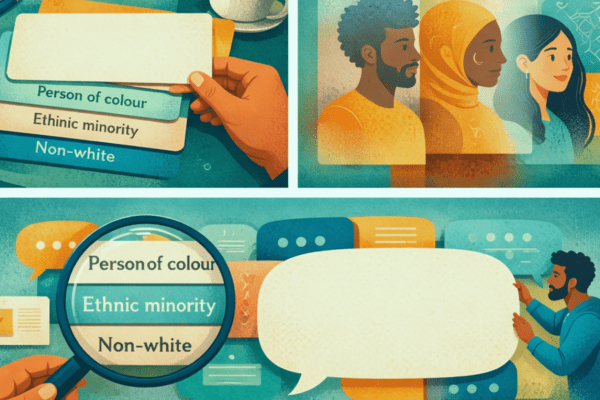
There is an inherent tension between the rich and varied terms people like to use for their complex and multi layered identities, and the need for cross-cutting terms that highlight wider injustice and bring shared experiences together. In many of the focus groups, participants struggled to think of terminology that occupied this middle ground; to find the right terms with which to encompass the complexities of our identities but are also broad enough to provide a bigger picture of the injustices occurring.
The answer may be to recognise this is an impossible ask, and to differentiate statistical data from language about identity. Focus group participants were comfortable with the function of categorisation to fulfil specific aims, for example, to assess your medical risk of diabetes, because we have statistics that show some ethnic communities experience different health outcomes in this area.
This reflects a “broad level of pragmatic consent” for seeing ethnic data as a relevant tool of research and policy analysis. However, we did record mixed responses to the validity of the current ONS categories themselves, and there is still a question as to the utility and feasibility of broader collective terms that speak to a shared understanding of racism and discrimination.
It is clearly important that we recognise the individual clarity around language that is so important to communities. How then, do we build collective voices to address injustice?
As communities value themselves more and develop stronger community identities within the UK, they may turn to more specific terms to capture their experiences and shared identities. Terms like South Asian or Black African feel too broad in today’s world where there is an increased understanding of the complex heritages, politics, and culture of people from different countries in south Asia, or across the continent of Africa. A young person in our Sheffield focus group drew attention to the ways in which collectivity is deployed against Black and Brown people.
“White people, like English White people, can act independently, whereas with Brown and Black people, we all of a sudden become spokespeople for our communities without wanting to. So if Zarah Sultana was to do something, all Pakistanis, all Brown people, all Muslim people, are labelled, but if a White person was to do it, they alone are responsible for their actions, and it creates a target on our back. I saw a video, and it was related to the grooming gangs that happened in March, and it spoke about the terminology and the language that’s used in these articles. And it spoke about how Asian people were all one. And it made reference to Asian communities, Asian people, it grouped them all as one, whereas when it came to English grooming gangs, they made sure to separate them and to talk about the fact that it wasn’t really that big of a deal.”
– Focus Group Participant
This comment was contextualised not as a warning against collective terms, but rather a call to action for raising the level of literacy and consciousness when it comes to the ways in which racial terminology is deployed to group people, especially in the media.
Different racialised groups can be portrayed as monolithic, exclusive, and dangerous, and racial terminology deployed as a shorthand to reference their ‘otherness’. The terms people use to describe their identities are connected to heritages, connections, relationships, and kinships with people from all over the world.
As opposed to seeing them as faultlines in our national coherence, it paints a picture of a connected world. At the end our report, we included a beautiful contribution from a focus group participant, which we have repeated here. Dr Aanka Batta invites us to imagine otherwise, always a powerful clarion call to remake our futures:
This language is so suffocating, like emotionally, to have to constantly tick box all these categories when you go to the GP surgery or whatever. It’s so suffocating to see the look in White British society’s eyes when you are telling them who you are, answering this question. And actually, like pre-colonial eras, cultures were giving names to each other based on rivers and based on locations and things and actually, something in me feels very beautiful and nice when I recognise that.
I just, I’m so tired of centering this colonial Anglo language on us, and so exhausted by it that actually I wondered if we can make more art with the language that existed before this, or the language that was growing before this. Like in the 13th century, we were curious about each other and about each other’s religions. And Sikh gurus travelled as far as Greece, and Persian Sufis came to Kashmir. I wondered if we can send that centre stage, that in maybe through art, or through higher education or something more.”
– Dr Aanka Batta – Focus Group Participant
This blog is part of a series on our Racial Terminology Project. To find out more and access our guide, visit here.