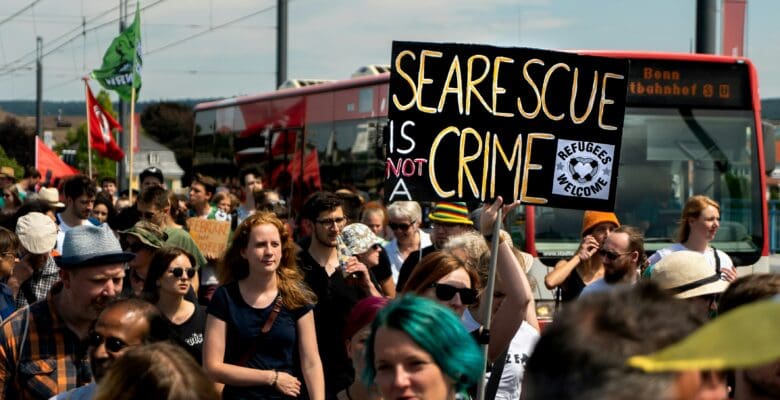
As we mark Refugee Week/World Refugee Day with this guest blog by Islington Refugee and Migrant Forum, we look at how migrants have become ‘the enemy’ according to the far-right.
Estimated read time: 4 minutes
Securitisation is when a state or political leader takes an ordinary political issue and frames it as an existential threat requiring ‘exceptional’ emergency measures; often bypassing normal democratic rules, norms and, at times, human rights.
As globalisation, EU free movement, and the 2015 refugee crisis intensified domestic anxieties, anti- EU politicians have exploited this to channel economic and cultural anxiety into an anti-migration movement pushing policy increasingly to the right.
In the last decade, the UK, Europe and the US have seen heightened fear of those perceived as ‘outsiders’, manifesting in the rise of populism and the far right. The securitisation of migration paints migrants and ethnic/religious minorities as a domestic, sovereign threat; infringing on the economic, cultural or criminal security of the country.
This dehumanisation has a trickle-down effect, widening to ethnic and religious minorities more broadly, and legitimising them as targets for open discrimination and hate-based violence. Often, this focus on migration as a security threat means other security threats are neglected and priorities become misguided.
Birthing a Hostile Environment
In a speech in 2011, the then Prime Minister, David Cameron stated that the UK:
can’t cope with the demands of ever greater numbers flooding in […] excessive immigration brings pressures [..] on schools, health care and social pressures. [..] I want everyone in the country to help with this, including by reporting suspected illegal immigrants to our Border Agency.
This is an example of securitising speech. It frames migration as a ‘flood’ straining public services and national cohesion. By calling on the public to report ‘suspected’ illegal migrants, this speech legitimises a form of exceptional politics and civilian border policing that directly prefigures the ‘Hostile Environment’.
The Hostile Environment policies were implemented to make life as difficult as possible for undocumented migrants by embedding immigration checks and surveillance into areas not typically associated with border control, such as housing, healthcare and employment.
The human cost of this became visible in the Windrush scandal (2018), where Commonwealth citizens with every legal right to remain in the UK were wrongly detained and deported as a direct consequence of the Hostile Environment.
Despite harsher policies, illegal border crossings continued to rise, and thus, the intentional deterrence of the Hostile Environment had failed (with 2022 being the year with the highest amounts of crossings since records began).
An environment unchanged?
But, despite Labour succeeding the Conservatives in 2024, many of the mechanisms and the ethos of the Hostile Environment have continued, with the Labour Government implementing harsh immigration policies.
Despite a focus on the gangs, the PM, Sir Keir Starmer, still utilises securitising language against migrants. In May 2025, his Immigration White Paper speech described the UK as ‘becoming an island of strangers’, urging that Labour would ‘finally honour what “take back control” meant’.
But in the context of the rise of Reform, the Southport riots (July 2024) and the UK’s largest recorded right-wing protest in September 2025, the PM’s language is not neutral and facilitates an environment where grievances of the far right are validated, and where minorities are viewed as justified targets of violence as they have been framed as a security threat to the country.

Photo: Lachlan Gowen. Unsplash
However, the stats paint a different picture.
In 2025, extreme right-wing referrals to Prevent accounted for 21% of all referrals (1,798 cases) – more than double the 10% recorded for Islamist extremism (870 cases).
For those referrals where ethnicity was specified (4,203), 65% (2,747) of referrals were recorded as White, 19% (798) were Asian, and 8% (320) were Black.
In the same year, police recorded a 6% increase in race hate crimes and a 3% increase in religious hate crimes from 2024, with a 19% spike in anti-Muslim offences following the Southport murders and subsequent disorder. Similar patterns of unrest and reported hate crimes in Belfast and Glasgow followed recent unrest in Belfast after an alleged knife attack involving an asylum seeker.
Where ethnicity was known, almost a quarter of victims identified as Black (23%) and a third as Asian (33%) – over 56% combined – highlighting that it is black and brown bodies that bear the brunt of securitising rhetoric.
It is not clear if these victims were migrants or British nationals; but to those committing these offences, they are indistinguishable, making the securitisation of migrants inseparable from broader racial justice.
The growing recognition that the migrant and racial struggles are becoming increasingly intertwined is precisely why organisations like Action for Race Equality and the Islington Migrant and Refugee Forum must work together by sharing analysis, building solidarity, and informing those on the frontline to challenge the rhetoric. The ‘other’ is a political construction, and dismantling it requires us to stand together.
Featured Image: Mika Baumeister on Unsplash

Cody Cunningham
Islington Refugee and Migrant Forum