
• Skip to primary navigation
  • Skip to main content
  • Skip to primary sidebar
Action for Race Equality

Action for Race Equality

Empowering Young People who are Black, Asian and of Mixed Heritage

  • Donate
  • ARE at Work
    • Programmes & Projects
      • Building Ethnic Diversity in the Youth Employability Sector
      • Evidence into Action
      • The Graduate Connector Programme
      • Routes2Success
      • Stronger Futures
      • UPLIFT Programme
      • Windrush Justice Programme
    • Education
    • Employment
      • Ethnicity Pay Gap
      • A Journey to Inclusion
    • Criminal justice
      • Alliance for Police Accountability
      • The Gangs Matrix
    • Policy and Research
      • Donate
  • Who we ARE
    • Team
    • Trustees
    • Funders
    • Youth Action Network
    • History
  • ARE Community
    • Voluntary & Community organisations
    • Young People
    • Schools, colleges and training organisations
    • Collective Impact Partnerships
    • ARE as policy makers and researchers
    • Diversity & Inclusion Experts
    • Media
    • Businesses
  • Training & Consultancy
  • ARE Voices
  • Take action
    • Work with us
    • Youth Voice
  • Show Search
Hide Search
Home/ARE comment/Healing Trauma: The Power of Community-Led Justice

Healing Trauma: The Power of Community-Led Justice

Our criminal legal system is entrenched in institutional racism but ‘led-by and for’ organisations provide communities with resilience against the discrimination they face.

Rooted in shared lived experience, these organisations understand the unique challenges of Black, Asian, and Mixed Heritage people. They defend disenfranchised young people and create opportunities in their lives.

These organisations are best placed to end racial disparities, but they deserve recognition and sustainable, ring-fenced funding to do so. 

Racial disparities in UK policing and the impact on young people 

The state of British policing is bleak. It has repeatedly been found guilty of institutional racism, lack of accountability and failure to reform practices that disproportionately impact Black, Asian and Mixed Heritage young people.  

These experiences in the criminal legal system are antithetical to the idea of common citizenship which advocates for uniting people from different backgrounds. Statistics on joint enterprise and that Black children are 6.5x times more likely to be strip searched, reveal how young people are systematically traumatised by an institutionally racist system. 
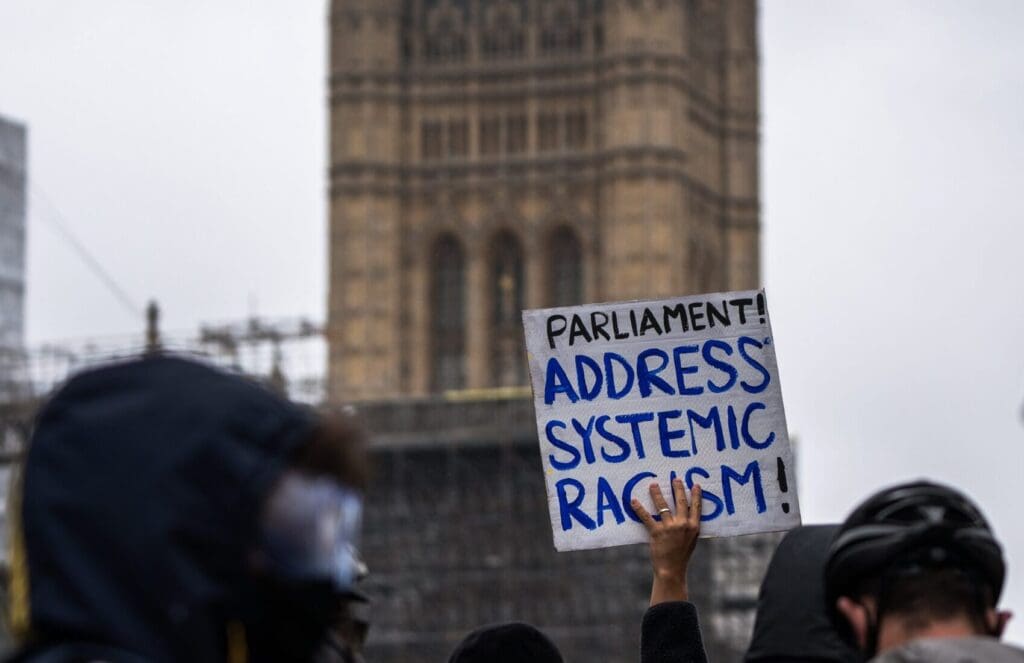
Against this backdrop, Black, Asian and Mixed Heritage young people are often excluded from the rule of law, dehumanised and adultified. Led-by and for organisations work against discriminatory policing and criminal legal system practices by providing culturally competent services in which children and young people are treated with respect and dignity. 

The truth about two-tier policing 

Following the racist riots in the summer, there were claims of a two-tier policing system that favoured ethnic minorities. These claims are insulting and unfounded. Black, Asian and Mixed Heritage people have never been respected or treated fairly by UK policing. On the contrary, interactions with the police have been historically contentious.

Did you know?

  • Black people are 2.2x times more likely to be arrested than White people
  • the rate of stop and search of people from the Black community is four times higher than for White people
  • Black people are three times more likely to have forced used against them than White people.

As a result, the relationship between the police and Black people is marred by continuous low levels of trust. 

Moreover, Black, Asian and Mixed Heritage young people are also criminalised in and by non-police institutions. In 2022, Black and Mixed Heritage pupils had the highest suspensions rates, with Mixed Heritage pupils having the highest suspension rates and the second highest permanent exclusion rates. This over-policing of young people feeds into the vicious cycle of criminal behaviour, otherwise known as the PRU to prison pipeline. 

The need for Led-by and for organisations 

Led-by and for organisations focus on the root causes of offending —systemic racism, socio-economic and educational exclusion. They do so through culturally sensitive programmes and support, such as mentoring programmes with empathetic role models, as well as diversionary initiatives designed to keep young people out of the system.

For instance, diversion programmes offer young people the chance, after arrest, to address their behaviour in alternative ways that prevents further escalation into the criminal legal system. Despite the success of these interventions, many led-by and for organisations are facing funding challenges. This funding crisis jeopardizes their sustainability and ability to deliver long term positive outcomes for young people. 

By recognising triggers of criminal behaviour, these organisations also effectively advocate for people’s intersectional lives. Action for Race Equality has long championed the involvement of people with lived experience in the planning and delivery of programmes and interventions. Given the disproportionate criminalisation of Black, Asian, and Mixed Heritage young people, these organisations are vital for creating positive social identities. 

A path forward: community-led justice 

The current model of policing is failing. Empowering led-by and for organisations to have a stronger voice, shifting power dynamics and making policing less punitive and more collaborative is required to end the deeply embedded institutional racism in policing.”

It is unrealistic and dangerous for the police to continue undermining the effect they have on marginalised communities. By seeking the advice and knowledge from experts through their lived experience, policing can evolve to become an institution that equitably serves and protects all communities.  

Bowale Fadare

Author

Policy & Research Officer, ARE

    More like this…

    Ten Years On: What has changed since The Young Review?

    Make More Launches “Healing Through Justice”: A Well-Being Project for Windrush Survivors

    Police Disclosure of Suspect Ethnicity and Nationality 

    Published on:
    13/01/2025

    Categories: ARE comment, ARE news, ARE opinion, ARE voices, criminal justice, newsTags: ARE Opinion, ARE voices, blog, criminal justice, policing, policy, racism

    Primary Sidebar

    Areas of work

    • News
    • Education
    • Employment
    • Criminal justice
    • Training & Consultancy
    • Policy & Research
    • ARE voices

    Latest

    • Ten Years On: What has changed since The Young Review?
    • Project Development and Engagement Officer
    • Met Police’s review of its vetting and hiring practices highlights serious failings; so, let’s not use EDI as a scapegoat.

    Popular

    • The Hamilton Commission
    • Response to Public Accounts Committee on apprenticeships
    • Institutional racism, a leadership challenge
    • Is prison really a holiday camp?
    • National Probation Service London roundtables

    Explore more

    Looking for information on a completed Action for Race Equality project? If you can’t find it on our website, let us know.

    Services for business and not-for-profits.

    Training and Consultancy

    Footer

    Registered Charity No 1056043
    Company registration No 03203812

    Action for Race Equality © 2026

    • Privacy Policy
    • Safeguarding Policy
    • Contact
    • Training & Consultancy
    • News
    • Opportunity
    • Publications
    We use cookies on our website to give you the most relevant experience by remembering your preferences and repeat visits. By clicking “Accept All”, you consent to the use of ALL the cookies. However, you may visit "Cookie Settings" to provide a controlled consent.
    Cookie SettingsAccept All
    Manage consent

    Privacy Overview

    We use cookies to improve your experience while you navigate through the website. Out of these, the cookies that are categorised as necessary are stored on your browser as they are essential for the working of basic functionalities of the website. We also use third-party cookies that help us analyse and understand how you use this website. These cookies will be stored in your browser only with your consent. You also have the option to opt-out of these cookies. But opting out of some of these cookies may affect your browsing experience.
    Necessary
    Always Enabled
    Necessary cookies are absolutely essential for the website to function properly. These cookies ensure basic functionalities and security features of the website, anonymously.
    CookieDurationDescription
    cookielawinfo-checkbox-analytics11 monthsThis cookie is set by GDPR Cookie Consent plugin. The cookie is used to store the user consent for the cookies in the category "Analytics".
    cookielawinfo-checkbox-functional11 monthsThe cookie is set by GDPR cookie consent to record the user consent for the cookies in the category "Functional".
    cookielawinfo-checkbox-necessary11 monthsThis cookie is set by GDPR Cookie Consent plugin. The cookies is used to store the user consent for the cookies in the category "Necessary".
    cookielawinfo-checkbox-others11 monthsThis cookie is set by GDPR Cookie Consent plugin. The cookie is used to store the user consent for the cookies in the category "Other.
    cookielawinfo-checkbox-performance11 monthsThis cookie is set by GDPR Cookie Consent plugin. The cookie is used to store the user consent for the cookies in the category "Performance".
    viewed_cookie_policy11 monthsThe cookie is set by the GDPR Cookie Consent plugin and is used to store whether or not user has consented to the use of cookies. It does not store any personal data.
    Functional
    Functional cookies help to perform certain functionalities like sharing the content of the website on social media platforms, collect feedbacks, and other third-party features.
    Performance
    Performance cookies are used to understand and analyze the key performance indexes of the website which helps in delivering a better user experience for the visitors.
    Analytics
    Analytical cookies are used to understand how visitors interact with the website. These cookies help provide information on metrics the number of visitors, bounce rate, traffic source, etc.
    Advertisement
    Advertisement cookies are used to provide visitors with relevant ads and marketing campaigns. These cookies track visitors across websites and collect information to provide customized ads.
    Others
    Other uncategorized cookies are those that are being analyzed and have not been classified into a category as yet.
    SAVE & ACCEPT
    Go to mobile version