

Back in May 2025, we came together with Business in the Community (BITC) to launch the Race Equity in Employment Task Force, a bold partnership aimed at tackling one of the most persistent inequalities in the UK: the barriers that hold back Black, Asian, and Mixed Heritage young people aged 16–24 from fair access to work.
🕒 Estimated read time: 4 minutes
The goal was simple, but urgent: a group of key leaders would come together to drive systemic change so that every young person can thrive in employment, free from the barriers of discrimination and inequity.
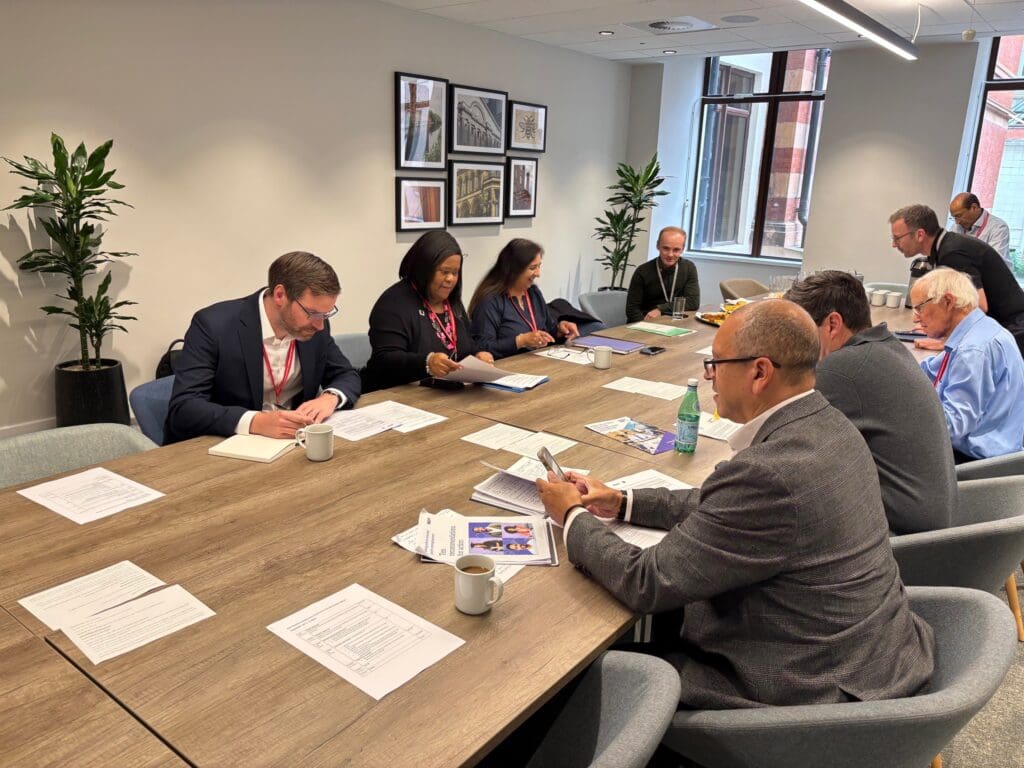
When the Task Force reconvened in September 2025, the focus turned to a crucial moment in young people’s lives: the transition from education to employment, and the fast-changing landscape in which that happens.
What happens at 16 can often shape an entire future, but for Black, Asian, and Mixed Heritage people so many of those pathways remain closed off. As modern technologies including AI continue to advance in our everyday lives, the focus on this key stage must be increasingly present.
Ambition without opportunity
At the meeting, members shared compelling insights from across research, policy, and lived experience. Raj Patel, Associate Director of Policy at Understanding Society (University of Essex), stressed that young people from Black, Asian, and Mixed Heritage backgrounds have high aspirations, but the pathways available to them often don’t match those ambitions.
Anthony Heath CBE, FBA, Senior Research Fellow at Nuffield College Oxford University, stressed that disadvantage begins far before a young person reaches the employment sector, with disparate outcomes occurring in education settings.
This is particularly pronounced in Mixed White and Black Caribbean groups. According to 2023 data from the Education Policy Institute, by the end of secondary school, the majority of ethnic groups attained higher GCSE grades than White British pupils, except for Mixed White and Black Caribbean pupils.
Recent research by the charity Impetus, indicates that young people from the Mixed White and Black Caribbean group are 28% more likely to not be in education, employment, or training (NEET) than the average.
These figures aren’t just statistics — they represent real young lives, brimming with potential but too often limited by structural barriers.
Rethinking pathways: work experience, mentoring, and fairer access
The Task Force shared concerns that traditional routes to employment such as obtaining a graduate degree may no longer be the best option, as disparities in opportunities for graduates continue.
Analysing 17 large employers and data from 2 million young people, researchers from University College London found that although Black and Asian applicants are overrepresented in graduate applicant pools, they are less likely to receive job offers than White applicants.
The researchers also found that employers are disproportionately filtering out graduate candidates from disadvantaged backgrounds and ethnic minority groups throughout the application process. Not only is this unfair, but it also illustrates how entrenched biases in employment are depriving talented young people of success.
The employment sector also continues to rapidly change with advancements in AI, which risks widening the gap for those already underrepresented in the workforce. Carmen Watson, Chair of Pertemps Network Group, shared growing concerns about artificial intelligence reshaping entry-level roles, particularly in law, where tasks once done by paralegals are now completed using AI.
Barry Fletcher, Chief Executive at Youth Futures Foundation (YFF), echoed these concerns, noting that in the US, jobs most exposed to AI have already seen a 13% decline among young people aged 22–25.
Task Force members agreed that change must start with opportunity. Mayor of Newham, Rokhsana Fiaz, is currently exploring an initiative that will ensure every 16–18-year-old has access to paid work experience. Meanwhile, Task Force Chair Mayor of Greater Manchester Andy Burnham, is planning to roll out increased numbers of T Level placements – 45-day work placements – by 2030, giving young people hands-on experience that builds confidence and opens doors.
Mentoring can also be transformative for young people. Howard Dawber, Deputy Mayor of London for Business and Growth, outlined plans for every young person in London to have access to a mentor.
What’s next?
According to BITC, one in five of the working-age population is from an ethnic minority. By 2051, the ethnic minority working-age population is expected to grow to nearly a third. Yet, despite ambition and talent, too many young Black, Asian, and Mixed Heritage people are being locked out of opportunity.
The Task Force will meet again in January 2026, continuing its mission to ensure that every young person – regardless of their race, background, or postcode – can access meaningful, rewarding work.

Author
Bowale Fadare
Policy and Research Officer